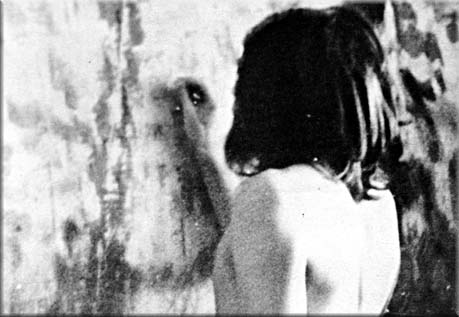
July 1981

Icon

Uncovering the Truth About the 1981 Hunger Strike

Pádraic Wilson in Andersonstown News

You can’t rewrite history, says leading republican
Andersonstown News,Thursday 21st of August 2009
By Anthony Neeson

A leading Belfast republican has told a hunger strike commemoration in the West of the city that you can’t rewrite history.

Pádraic Wilson was speaking at a gathering of several hundred people in Whiterock Leisure Centre on Sunday evening.

Earlier that day republicans had taken part in a march commemorating the 1969 pogroms as well as a hunger strike rally in County Tryone.

Mr Wilson said that while republicans were used to being demonised by political rivals and the mainstream media, now some “former comrades” had “aligned themselves” with revisionism.

Speaking about the former he said: “They vilified and demonised our comrades, their families and each and every one of us.

“They provided a rationale for the murderous attacks against the Relatives’ Action Committees and others.

“In recent times there have been attempts, led by some of the same people, to rewrite the history of that period.

“If we didn’t know better we could be forgiven for thinking that these people actually cared about our comrades or their families.”

He said people needed to be clear about a number of things.

“The British government, led by Thatcher, was not an honest broker trying desperately to find a solution to a situation for which they had no responsibility.

“Thatcher had shown quite clearly in December 1980, when the opportunity for a solution to the situation in the H-Blocks and Armagh arose, that she had one intention and one only, and that was to demoralise us, crush us, and to deliver a death blow to republican resistance. According to her we had played our last card… the game was still going in Brighton in 1984, Maggie.

“She and her allies failed inside the prisons and they failed on the outside.

“They failed because we, and that means those of us who were in prison, those of you who fought and campaigned on the outside, and those of you who provided the resources for that, all of us refused to be intimidated, refused to bow down and refused to be criminalised.

“While we expect it from those quarters, there are others, some of them former comrades, who have aligned themselves with this revisionism. The logic of their position is that our comrades were like sheep being led aimlessly along.

“That is an insult and it needs challenged.”

Mr Wilson spoke about Andersonstown hunger striker Kieran Doherty, a man he knew well, and recalled the punishment that he and others endured in the H-Blocks.

“I’ve been asked at various times over the years if it was all worth it,” he told the audience. “I’ve always responded that everything that I’ve experienced and all that I’ve been a part of were necessary and worthy.

“Mindful that some people might think that’s an easy answer to give because I’m alive and well, I can only say that any other response would be a lie and a betrayal.”

Sourced from the Andersonstown News

  • Print
  • email
  • Add to favorites
  • Twitter
  • Facebook
  • Netvibes
  • MySpace
  • Google Bookmarks
  • Live
  • Digg
  • del.icio.us
  • NewsVine
  • Technorati
  • StumbleUpon
  • FriendFeed

Pádraic Wilson: The hunger strikes of ’81 and what they mean today

The hunger strikes of ’81 and what they mean today
Andersonstown News
Thursday 14th of August 2009
by Francesca ryan

The 1981 hunger strike is to be remembered at an event being held at Whiterock Leisure Centre this Sunday.

Leading Belfast republican Pádraic Wilson will share his memories of his time on the blanket and the dark days of 1981.

Pádraic, Sinn Féin’s Director of International Affairs, spent three separate stints in prison and recalls vividly the effect both the hunger strike and the hunger strikers had on him.

Pádraic told the Andersonstown News that the talk will focus on his time in Long Kesh from 1976 to 1982.

“I was in Long Kesh during the blanket protest and the hunger strikes of 1980 and 1981,” he said.

“I knew most of the hungerstrikers, some from the outside and others I got to know while inside. I will be talking about the hunger strke in general and what it meant for me.”

Pádraic says it was Kieran Doherty who gave him the morale boost he needed to get through the bleakest of times in Long Kesh.

“Of all the hunger strikers, I knew Kieran Doherty the best,” he said.

“He lived a few streets away from me and was just a few years older than me.

“Kieran was someone everyone looked up to, literally, because of his height, but also because he was an inspiration.

“Big Doc just instilled confidence in everyone, he was practically fearless. Just standing beside him at Mass on a Sunday – the only time we were allowed out of our cells – was enough to boost my morale.

“Even the screws were afraid of him and would never take him on one-to-one like they would have done with the others. He was the one who kept my morale going.”

Pádraic is also ready to address the current debate surrounding the hunger strike.

“There is no way I could talk about that time without mentioning that there is some controversy at the minute regarding the hunger strike.

“For anyone to suggest that Margaret Thatcher and her government wanted to offer a deal that republicans rejected, well, they need their heads examined.

“I intend to talk about this in reference to the hunger strikes of 1980 and 1981.”

Pádraic will also touch on the path republicanism has taken in the years following the hunger strikes right through to today’s peace process.

“I’m going to speak about the relevance of the hunger strike in terms of where we are now.

“For me, it is the same struggle with the same objectives, the only thing that has changed is the way of achieving the objectives.”

Pádraic will be speaking at the commemoration night in Whiterock Leisure Centre this Sunday (August 16).

Admission is £5 and the doors open at 7pm.

Sourced from The Andersonstown News

  • Print
  • email
  • Add to favorites
  • Twitter
  • Facebook
  • Netvibes
  • MySpace
  • Google Bookmarks
  • Live
  • Digg
  • del.icio.us
  • NewsVine
  • Technorati
  • StumbleUpon
  • FriendFeed

Gerry Adams recalls Kieran Doherty

Note: See also Before the Dawn, pages 308-310.

Monday, August 3, 2009
Fair Play
Gerry Adams, Leargas blog

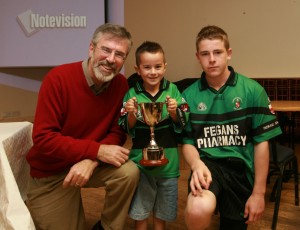
doherty_cupJoe McDonnell’s grandson Caolan presents the Joe McDonnell Cup to Captain Gary Lennon of Sarsfields
3 Lúnasa 2009

FAIR PLAY.

On Saturday afternoon this blog travelled to Saint Teresa’s Club in Belfast to watch the play offs in the Joe McDonnell – Kieran Doherty Football Tournament.

Joe and Kieran who died on hungerstrike in the H Blocks in 1981 were Saint Teresa’s men. The very fine playing facility on the Glen Road bears their names, Páirc Mhic Dhomhnaill Uí Dhocartaigh.

Each year the club organises a very competitive days sport for Under 16 players in their memory. Fair play to the organisers, the referees and most especially the players and mentors. Joe and Kieran would have enjoyed the day out. They were good Gaels.

Joe, a wee bit older and a wee bit smaller than Kieran was a good sportsman, resourceful in a skirmish and inclined to play on the referee’s blind side. But always for the devilment of it. He was not a cynical player. In football or anything else. Doc was a big guy. Six foot three inches tall. Maybe in another era he could have been county material. He won a minor medal with Saint Teresa’s and although the struggle interrupted his sporting life Kieran stayed fit, energetic and athletic.

I thought of Doc and Joe as I sat with my back to the Black Mountain. The city of Belfast stretched before us away off to the middle distance and the Craigantlet Hills. To our left the Cavehill looked down its nose at Belfast Lough and to our right lightly shrouded in rain in the far distance, the Mournes swept down to the sea. Impervious to all this, Saint Teresa’s and Naomh Pol Under 16s battled it out in the final of one competition and Eoin Roe’s and the Paddies (Sarsfields) in the other. Eoin Roe’s are a Tír Eoghan club and they play good football but the Paddies were better on the day. Saint Teresa’s were victorious as well. Seven clubs in all participated.

The Pearse’s turned up with their Under 16 hurlers but they couldn’t get a game. Communications, communications, communications!! But fair play to the stalwarts who keep this very fine club going. It was terrific to see such a fine squad of young hurlers ready to do battle for their team.

I got to do some of the presentations afterwards. Caolan McDonald, Joe’s grandson did the rest. And a fine job he did as well.

Between them all and all the other young athletes who turned up at the Feile an Phobal Carnival opening on Sunday morning, methinks the future of the gaelic games is secure in Aontroim. Our camógs, hurlers and footballers are the sleeping giants of the GAA. Our senior footballers have shown what is possible. Fair play to them. They did us and our county proud.

Joe and Kieran would be pleased about that as well.

I went to the Féile Carnival from the commemoration at Doc’s house and the vigil on Andytown Road on Sunday morning. At the commemoration Big Bobby regaled us with tales of derring-do and other bits of loose talk laced with gems of political clarity and words of great wisdom.

Then Mrs Doherty sang for us. A song about her son.

I thought of the last time I saw Kieran. In the prison hospital in the H Blocks of Long Kesh. By this time he was the TD for Cavan Monaghan. It was the 29 July 1981. Kieran died on August 2.

‘I’m not a criminal.’ He said
.
‘For too long our people have been broken. The Free Staters, the church, the SDLP. We won’t be broken. We’ll get our five demands. If I’m dead … well, the others will have them. I don’t want to die, but that’s up to the Brits. They think they can break us. Well they can’t.’ He grinned self-consciously: Tiocfaidh ar lá.’

We shook hands before I left, an old internee’s hand-shake, firm and strong.

‘Thanks for coming in, I’m glad we had that wee yarn. Tell everyone, all the lads, I was asking for them and … ‘ He continued to grip my hand.

‘Don’t worry, we’ll get our five demands. We’ll break That¬cher. Lean ar aghaidh.

Talking later to Kieran’s father Alfie, his eyes brimming with unshed tears, in the quiet cells in the H-Blocks of Long Kesh, I felt a raw hatred for the injustice which created this crisis.

I am glad to say that I still feel the same today 28 years after Kieran’s death. And I am humbled that I knew him and Joe who died on July 8 1981, and the other hungerstrikers.

Fair play to them all. And to their families.


Sourced from Leargas blog

  • Print
  • email
  • Add to favorites
  • Twitter
  • Facebook
  • Netvibes
  • MySpace
  • Google Bookmarks
  • Live
  • Digg
  • del.icio.us
  • NewsVine
  • Technorati
  • StumbleUpon
  • FriendFeed

One reader still has questions about 1981 hunger strike

One reader still has questions about 1981 hunger strike
Andersonstown News Monday, Mala Poist

The recent and very private meeting between Provisional Sinn Féin and families of the 1981 hunger strikers seems to have left us with even more questions unanswered than there was before the meeting.

Firstly, I want to recognize that this is still a very emotional event for the families and no doubt also still very painful. I have difficulty writing this letter for these reasons. But the truth is the hunger strike is such an historic event that anything concerning it will always attract a lot of attention. 

The families recently released a statement through PSF press office asking for the allegations that the Provisional leadership turned down an offer that the prisoners thought was enough to end the hunger strike. For some of the families to say they want the controversy to end will not, unfortunately, make it go away.

The hunger strike and the slow death of the ten men reached all corners of Ireland and even well beyond our shores. Former blanketmen, even surviving hunger strikers and republicans have a vested interest in what happened in July 1981, as can be seen by the amount of them that attended the public, and packed meeting held in Derry’s Gasworks a few weeks ago. Adams and the PSF leadership refused to attend this meeting.

The British go-between to the Provisional leadership, the Mountain Climber, did attend and was open to questions from the public for the first time. He confirmed that O’Rawe’s account of the offer from the British was true. He also confirmed that the offer was rejected by the PIRA. What also came out at this meeting was that the INLA leadership inside and outside the H-Blocks knew nothing about the contact with the British. Two INLA prisoners died after the events of July 1981.

Since O’Rawe’s claims came out the reaction from PSF was fast and furious, so fast that they did not coordinate what they were saying as they contradicted each other in public, and also forgot what was already recorded in the public domain. 

Adams has remained totally silent on the issue since he was interviewed in two TV shows for the 25th anniversary in 2006, where in one show, for the BBC, he spoke openly about his role in the hunger strike and about the Mountain Climber with ease. Then O’Rawe’s claims came out and Adams in the RTé show denied he knew about the Mountain Climber, two totally different versions that are contradictory, both can not be true.

Mountain Climber

The Mountain Climber issue is now well documented, as one of the contacts with the British. But one contact that seems to have slipped under the radar is the contact Adams personally had with the British. In his book Before the Dawn, Adams, in his own words, says that he was on the phone to a British contact when Joe McDonnell actually died. 

Who was this contact and where are the transcripts of these conversations? Why the need for the Mountain Climber if Adams and his “kitchen cabinet” had direct contacts with the British?

There are lots of other questions that need to be answered about the role that Adams and his “kitchen cabinet” played during the hunger strike, for instance, in the same book, Adams also claims that the British always left it until the critical stage, as a hunger striker neared death, and phoned late at night believing that they (the “kitchen cabinet”) would be at a low ebb (now this is not the Mountain Climber contact, as that was all done in writing and only started on the 4/5 July) so he, Adams, got into the habit of cat-napping during the day to be fresh for these calls.

Now what has me confused about all of this is (1) what “critical stage” was there before Joe died that Adams had contact with the British? Surely that would be the first four strikers? (2) Did the prisoners and their families know about this contact, because as far as I can tell this contact is not recorded elsewhere. (3) It is obvious from his own words that Adams played a major role (key role?) in the hunger strike, yet now remains totally silent in public on what that role was. Why?

Finally, to the families I am sorry if this has opened old wounds for you, but this is not going to go away. The hunger strike and the men who died on it are such a massive part of our history that the events of 1981 will always be in the public domain and questions will be asked about the men and the hunger strike, just as questions are asked and examined about other major events in our history that wider society has a vested interest in, and that’s the way it should be.

Gerard Foster
Andersonstown

Sourced from The Andersonstown News

  • Print
  • email
  • Add to favorites
  • Twitter
  • Facebook
  • Netvibes
  • MySpace
  • Google Bookmarks
  • Live
  • Digg
  • del.icio.us
  • NewsVine
  • Technorati
  • StumbleUpon
  • FriendFeed

Recent Items

Contents

Use this link to access all contents

New to Archive


There's an inner thing in every man,
Do you know this thing my friend?

It has withstood the blows of a million years, and will do so to the end.