Mountain Climber’s Notes + Timeline
KEY:
DM = Danny Morrison
GF = Garret Fitzgerald
Other sources are noted in text.
July 4th: Prisoner’s statement about extending reforms through the prison opens direct contacts
DM: British government representative (codenamed ‘Mountain Climber’) secretly contacts republican leadership by ‘back channel’. Insists on strict confidentiality.
GF: “Following the conciliatory statement by the prisoners, direct contact had been made with the IRA by an agent of the British government, through an intermediary. Disastrously, his proposals, while close to what the prisoners and Allison, through the commission, were near to agreeing, went further in one respect. Not unnaturally the IRA preferred this somewhat wider offer, and above all the opportunity to be directly involved in discussions with the British government.”
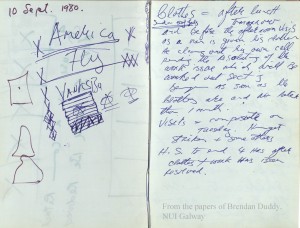
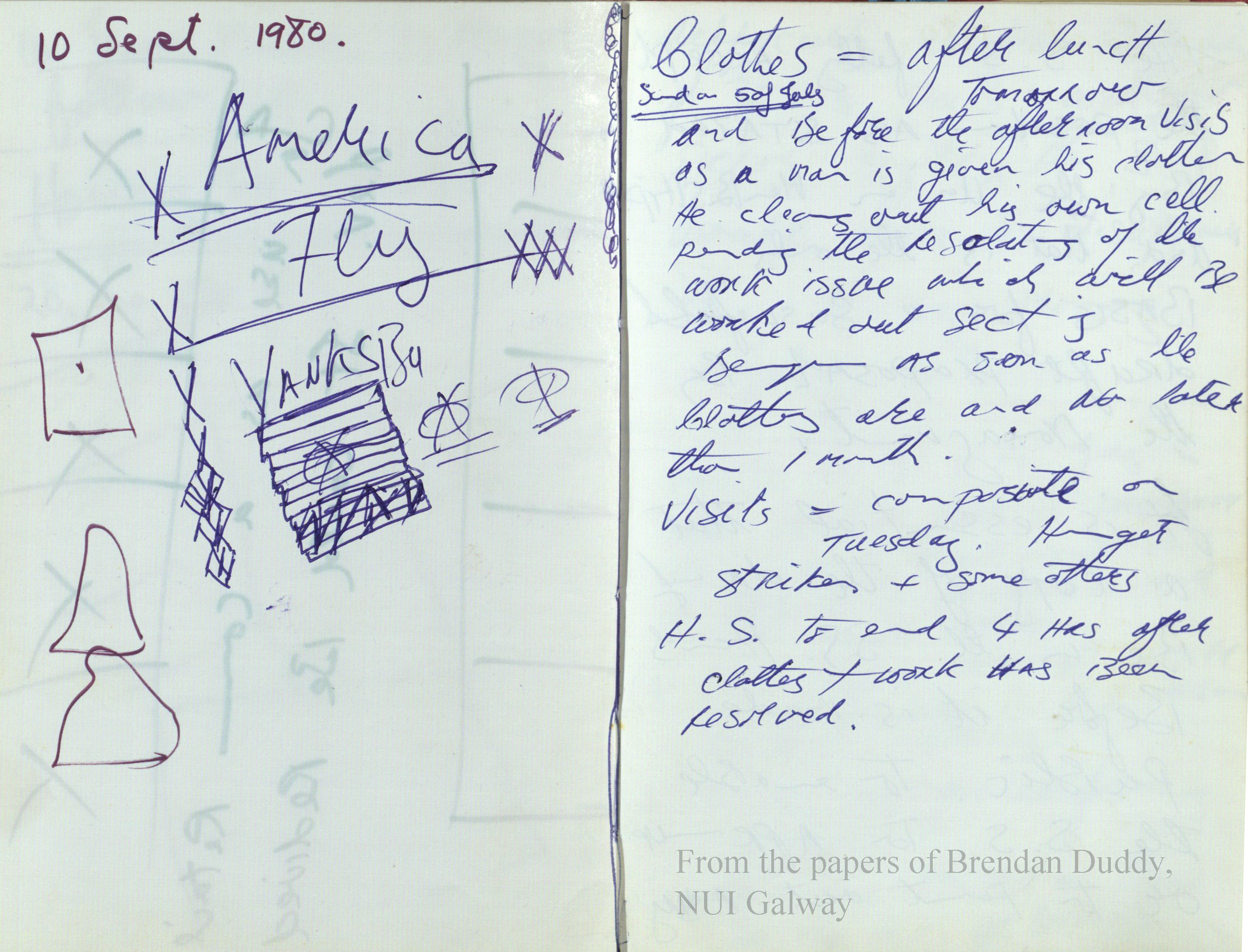
TRANSCRIPTION:
Send on 5 of July
Clothes = after lunch
Tomorrow
and before the the afternoon visit
as a man is given his clothes
He clears out his own cell pending the resolution of the work issue which will be worked out [garbled] as soon as the clothes are and no later than 1 month.
Visits = [garbled] on Tuesday. Hunger strikers + some others
H.S. to end 4 hrs after clothes + work has been resolved.
The Morning of July 5th: Morrison tells hunger strikers of Mountain Climber contact, but no details, as they were to see the ICJP later and their knowledge could jeopardise the Adams Committee negotiations. He tells Bik McFarlane of the offer, who discusses with with Richard O’Rawe. They agree to accept it.
Padraig O’Malley, Biting at the Grave, pg 96:
“…Danny Morrison was allowed to go into the Maze/Long Kesh to see the hunger strikers on the morning of 5 July…to apprise them of what was going on, although he did not go into detail. Morrison says that he relayed information about the contact and impressed upon them the fact the ICJP could “make a mess of it, that they could be settling for less than what they had the potential for achieving.”
GF: “They were then allowed by the British authorities to send Danny Morrison secretly into the prison for discussions with the hunger strikers and with the IRA leader there, Brendan McFarlane. This visit was later described by the IRA as a test of the authority of the British government representative in touch with them to bypass the NIO.”
DM: After exchanges, Mountain Climber’s offer (concessions in relation to aspects of the five demands) goes further than ICJP’s understanding of government position. Sinn Fein’s Danny Morrison secretly visits hunger strikers. Separately, he meets prison OC Brendan McFarlane, explains what Mountain Climber is offering should hunger strike be terminated.
Sources various: McFarlane returns to block; sends O’Rawe a run-down of the offer from the Mountain Climber. McFarlane, as told to Brian Rowan: “And I said to Richard (O’Rawe) this is amazing, this is a huge opportunity and I feel there’s a potential here (in the Mountain Climber process) to end this.” O’Rawe and McFarlane agreed there was enough there to accept the offer: “We spoke in Irish so the screws could not understand,” Mr O’Rawe told the Irish News.“I said, ‘Ta go leor ann’ – There’s enough there. He said, ‘Aontaim leat, scriobhfaidh me chun taoibh amiugh agus cuirfidh me fhois orthu’ – I agree with you, I will write to the outside and let them know.” Conversation confirmed by prisoners on the wing.
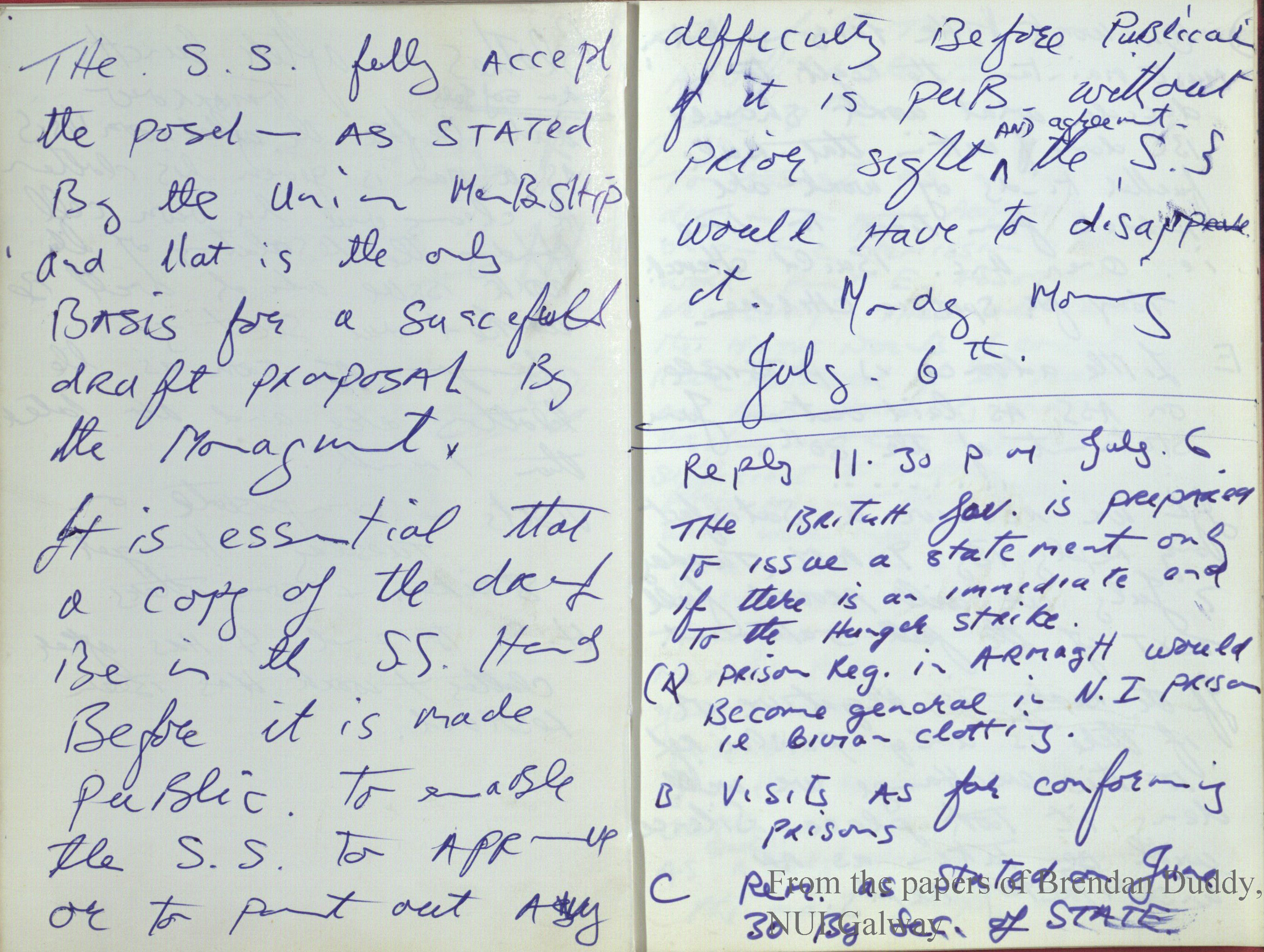
The Morning of July 6th: The prisoners’ acceptance of the offer is conveyed to the Mountain Climber; the details given on the 5th must form the basis of the draft proposal coming from the British in response to this news. The Adams Committee adds their own veto to the agreement, and sends word to the prisoners that, despite their acceptance, “more was needed”.
KEY:
S.S. = Shop Steward – code for the Adams Committee which included Gerry Adams, Danny Morrison, Tom Hartley, Jim Gibney and Martin McGuinness
Union Membership or The Workers = the prisoners, as represented by Bik McFarlane (OC) and Richard O’Rawe (PRO)
The Management = The British Government (Thatcher)
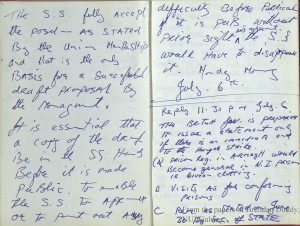
TRANSCRIPTION:
The S.S. fully accept the posal — as stated by the Union MemBship
And that is the only Basis for a successful draft proposal by the Management.
It is essential that a copy of the draft be in the S.S. hands Before it is made public.
To enable the S.S. to apr – up
or to point out any difficulty before publication
If it is pub. without prior sight and agreement the S.S. would have to disapprove it.
Monday Morning
July 6th.
————————————–
Richard O’Rawe, Blanketmen, page 184:
“On the afternoon of 6 July, a comm came in from the Army Council saying that it did not think the Mountain Climber’s proposals provided the basis for a resolution and that more was needed. The message said that the right to free association was vital to an overall settlement and that its exclusion from the proposals, along with ambiguity on the issue of what constituted prison work, made the deal unacceptable. The Council was hopeful, though, that the Mountain Climber could be pushed into making further concessions. As usual, the comm had come from Gerry Adams, who had taken on the unenviable role of transmitting the Army Council’s views to the prison leadership.”
GF: “On Monday, 6 July at 3:30pm, according to the account given to me shortly after these events, Gerry Adams phoned the commission seeking a meeting, revealing that the British government had made contact with him. An hour and a half later two members of the commission met Adams and Morrison, who told them that this contact was ‘London based’ and had been in touch with them ‘last time round’, i.e. during the 1980 hunger strike. Adams demanded that the commission phone the NIO to cancel their meeting.”
GF: “Late that night, however, the commission was phoned by Danny Morrison seeking a meeting, which they refused; but half an hour later he arrived at the hotel, saying that the Sinn Fein-IRA contacts with the British were continuing through the night and that he needed to see the actual commission proposals. This request was refused, although he was given the general gist of them.”
————————————–
TRANSCRIPTION:
Reply 11:30 PM July 6
The British Gov. is preparing to issue a statement only if there is an immediate end to the hunger strike.
(A) Prison reg. in Armagh would become general in NI prison ie civian clothing
B Visits as for conforming prisons
C Re. as stated on June 30 by Sec of State
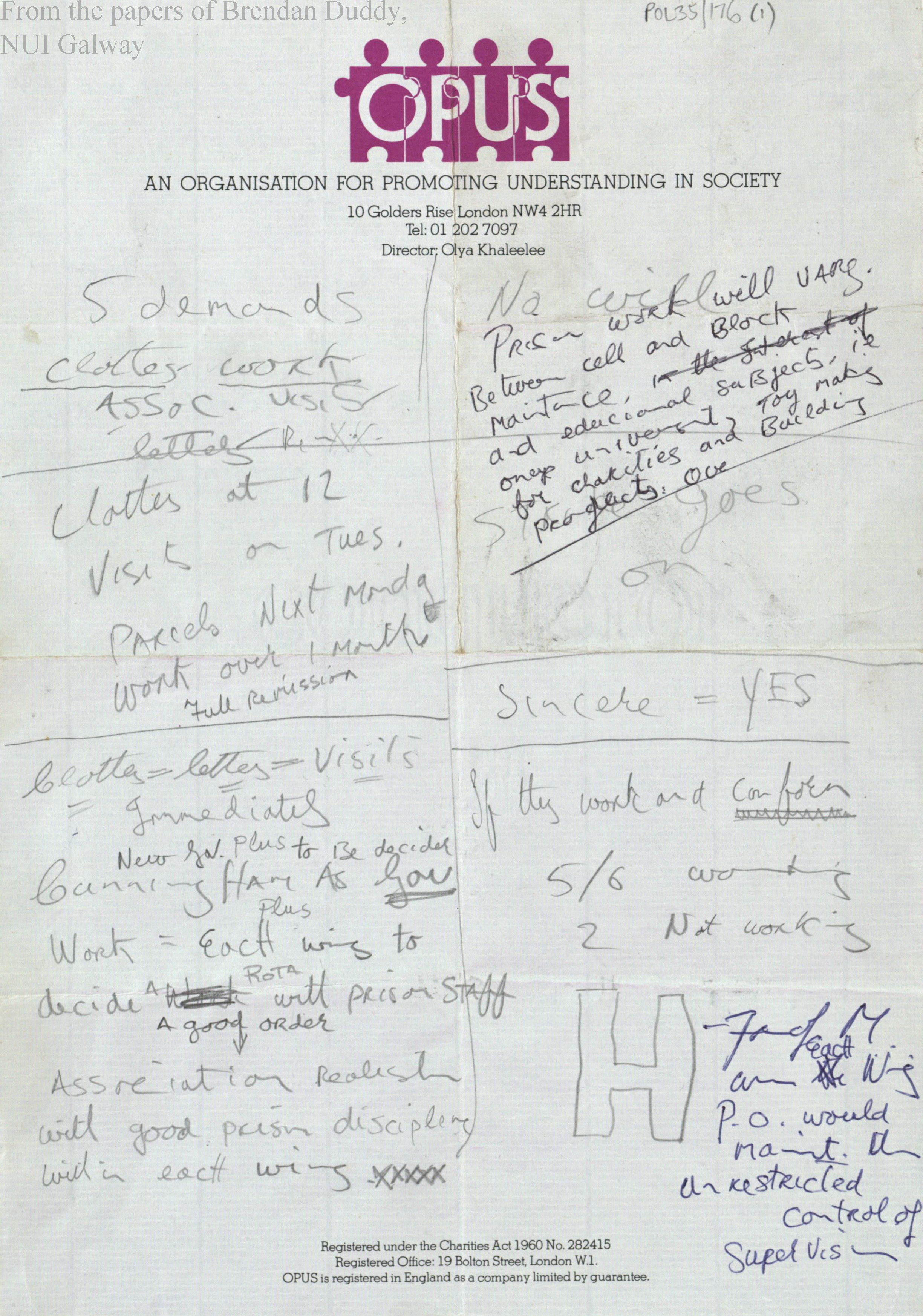
July 7th: The Adams Committee has been given the draft proposal they sought; they showed it to the ICJP who note the inclusion of education – specifically Open University course – as described in the Mountain Climber’s notes.
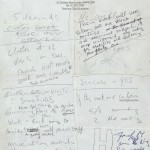
TRANSCRIPTION:
5 demands
clothes work
assoc. visits
letters re – XX
————————————–
Clothes at 12
Visits on Tues.
[Note: Tues, July 7, re Document 1]
Parcels Next Monday
Work over 1 month
Full remission
————————————–
clothes = letters = visits
Immediately
New Gov. Plus to be decider
Cunningham as Gov
Plus
Work = Each wing to decide a rota with prison staff
A good order
Association realistic with good prison discipline within each wing xxxx
————————————–
No Will
Strike goes on
[Note: Written in pen over ‘No Will Strike Goes On’]
Prison work will vary between cell and block maintenance, in the futherest of educational subjects, ie open university, toy making for charities and building projects: ove
[Note: this is clarified on the back of the page/Document 4]
————————————–
Sincere = YES
————————————–
If they work and conform
5/6 working
2 not working
H
Freedom of M
on the Each Wing P.O. would maint. the unrestricted control of supervision
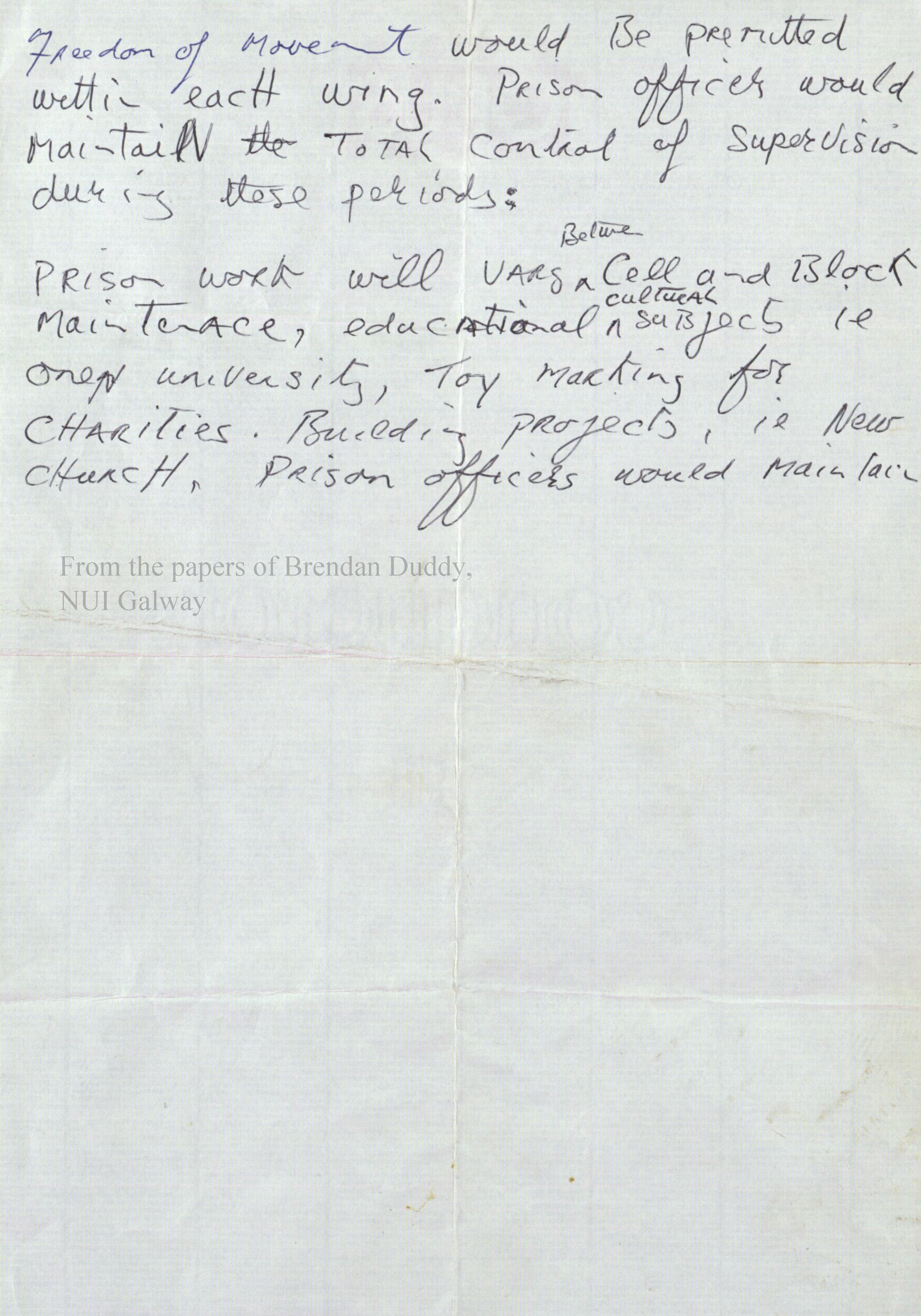
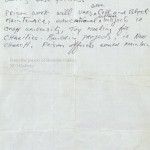 TRANSCRIPTION:
Freedom of Movement would be permitted within each wing. Prison officer would maintain the total control of supervision during these periods:
Prison work will vary between Cell and Block maintenance, educational, cultural subjects ie Open University, toy making for charities. Building projects, ie New Church. Prison officers would maintain
GF: “On Tuesday afternoon, Gerry Adams rang to say that the British had now made an offer but that it was not enough. Three members of the commission then met Adams and Morrison, who produced their version of the offer that they said had been made to them. The commission saw this as almost a replica of their own proposals but with an additional provision about access to Open University courses.”
FOI Document 1: “Extract from a letter dated 8 July 1981 from 10 Downing Street to the Northern Ireland Office”
“Your Secretary of State said that the message which the Prime Minister had approved the previous evening had been communicated to the PIRA. Their response indicated that they did not regard it as satisfactory and that they wanted a good deal more.”
“That appeared to mark the end of the development, and we had made this clear to the PIRA during the afternoon.”
DM: “Late afternoon: Statement from PRO, H-Blocks, Richard O’Rawe: “We are very depressed at the fact that our comrade, Joe McDonnell, is virtually on the brink of death, especially when the solution to the issue is there for the taking. The urgency of the situation dictates that the British act on our statement of July 4 now.””
FOI Document 1: “This had produced a very rapid reaction which suggested that it was not the content of the message which they had objected to but only its tone.”
DM: 4pm: NIO tells ICJP that an official will be going in but that the document was still being drafted.
Padraig O’Malley: Biting at the Grave, pg 97: “At one point, David Wyatt, a senior NIO official who had sat in on most of the discussions, rang to explain the delay: a lot of redrafting was going on and it had to be cleared with London.”
FOI Document 1: “The question now for decision was whether we should respond on our side. He had concluded that we should communicate with the PIRA over night a draft statement enlarging upon the substance of the previous evening but in no way whatever departing from its substance. If the PIRA accepted the draft statement and ordered the hunger strikers to end their protest the statement would be issued immediately. If they did not, this statement would not be put out but instead an alternative statement reiterating the Government’s position as he had set it out in his statement of 30 June and responding to the discussions with the Irish Commission for Justice and Peace would be issued. If there was any leak about the process of communication with the PIRA, his office would deny it.”
GF: “At 8:30pm, however, Morrison and a companion had come without warning to the hotel where the commission had its base. Their attitude was threatening. Morrison said their contact had been put in jeopardy as a result of the commission revealing its existence at its meeting with Allison; the officials present with Allison had not known of the contact. Despite this onslaught the commission refused to keep Morrison informed of their actions.”
DM: 10pm: Alison tells ICJP that no one would be going in that night but would at 7.30 the next morning and claims that the delay would be to the benefit of the prisoners. Republican monitors still waiting confirmation from Mountain Climber that an NIO representative will meet the hunger strikers. The call does not come.
GF: “At ten o’clock that night Allison phoned to say that the official would not now be going to the prison until the following morning – adding, however, that this delay would be to the prisoners’ benefit.”
Padraig O’Malley, Biting at the Grave, pg 97: “Asked by Logue why no representative had been sent into the prison that morning, Logue says that Alison replied, “Frankly, I was not a sufficient plenipotentiary.””
FOI Document 2: “Extract from a Telegram from the Northern Ireland Office to the Cabinet Office”
PLEASE PASS FOLLOWING TO MR WOODFIELD
MIPT contains the text of a statement which SOSNI proposes to authorise should be released to the hunger-strikers/prisoners and publicly. The statement contains, except on clothing, nothing of substance which has not been said publicly, and the point on clothing was made privately to the provos on 5 July. The purpose of the statement is simply to give precise clarification to formulae which already exist. It also takes count of advice given to us over the last 12 hours on the kind of language which (while not a variance with any of our previous public statements) might make the statement acceptable to the provos.
The statement has now been read and we await provo reactions (we would be willing to allow them a sight of the document just before it is given to the prisoners and released to the press). It has been made clear (as the draft itself states) that it is not a basis for negotiation.”
FOI Document 1: “The meeting then considered the revised draft statement which was to be communicated to the PIRA. A number of amendments were made, primarily with a view to removing any suggestion at all the Government was in a negotiation. A copy of the agreed version of the statement is attached.”
“The Prime Minister, summing up the discussion, said that the statement should now be communicated to the PIRA as your Secretary of State proposed. If it did not produce a response leading to the end of the hunger strike, Mr Atkins should issue at once a statement reaffirming the Government’s existing position as he had set out on 30 June.”
10pm Comm to Brownie from Bik:
“…I don’t know if you’ve thought on this line, but I have been thinking that if we don’t pull this off and Joe dies then the RA are going to come under some bad stick from all quarters. Everyone is crying the place down that a settlement is there and those Commission chappies are convinced that they have breached Brit principles. Anyway we’ll sit tight and see what comes…”
The 8th of July: The death of Joe McDonnell
DM: 4.50am Joe McDonnell dies on the 61st day of his hunger strike.
GF: “Just before 5:00am that night Joe McDonnell died. At 6:30 the governor, in the presence of an NIO official, read a statement to the prisoners that differed markedly from the one prepared by the commission, and, in their view, approved by Allison thirty-six hours earlier. Fifteen minutes later Adams rang the commission to say that at 5:30am the contact with London had been terminated without explanation.”
Gerry Adams, Before the Dawn, page 299:
“Very early one morning I and another member of our committee were in mid-discussion with the British in a living room in a house in Andersonstown when, all of a sudden, they cut the conversation, which we thought was quite strange. Then, later, when we turned on the first news broadcast of the morning, we heard that Joe McDonnell was dead. Obviously they had cut the conversation when they got the word. They had misjudged the timing of their negotiations, and Joe had died much earlier than they had anticipated.”
DM: 9am: An NIO official visits each hunger striker in his cell and reads out a statement which says that nothing has changed since Humphrey Atkins’ policy statement of 29 June, thus suggesting that there was no new document being drafted as claimed by the NIO at 4pm on 7 July.
John Blelloch:“[…] the problem as always was seeing whether we could find some fresh statement of the government’s position which respected all our, which abided by our principal objectives which we adhered to throughout the hunger strike but nevertheless constituted some sort of opportunity for the prisoners to come off it. As far as I remember the delay on that was actually getting final agreement to the text of what might be said, which was not easy, and in the event McDonnell died before that process could be completed and of course thereafter it collapsed.” – 1986 interview with author Padraig O’Malley
GF: “When we heard the news of Joe McDonnell’s death and of the last-minute hardening of the British position, we were shattered. We had been quite unprepared for this volte-face, for we, of course, had known nothing whatever of the disastrous British approach to Adams and Morrison. Nor had we known of the IRA’s attempts – regardless of the threat this posed to the lives of the prisoners, and especially to that of Joe McDonnell – to raise the ante by seeking concessions beyond what the prisoners had said they could accept.”
Sources: Danny Morrison, Garret Fitzgerald, John Blelloch, British Government documents, Ten Men Dead, Before the Dawn, Biting at the Grave, INLA Deadly Divisions, Blanketmen, Irish News, Belfast Telegraph, eyewitness accounts.
Expanded Timeline: 29 June – 12 July 1981


 It has withstood the blows of a million years, and will do so to the end.

