web analytics

July 1981

Icon

Uncovering the Truth About the 1981 Hunger Strike

Irish News letters: Judge the hunger strikers on their own brave deeds

Judge the hunger strikers on their own brave deeds
Irish News letters page
Manus McDaid, Derry
02/11/09

It is my hope that the recent extensive coverage by The Irish News of the Hunger Strike represents the paper’s contribution to the search for closure on this painful long-running argument about British intentions during the strike.

It is evident that there are those who have simply taken the word of the British on this matter although the British themselves are reticent to speak about it.

There are also some who forget or choose to forget the first Hunger Strike ended when the men on strike took the British at their word.

As I wrote before, these men were double-crossed.

I believe the men who went on the second Hunger Strike were well aware of that.

They were not going to make the same mistake and accept the word of a duplicitous British government. They wanted their demands agreed in writing and confirmed by a British official in person.

This, to my best knowledge, never happened.

I note Mr O’Rawe via one Mr Liam Clarke says the secretary of state “would release a statement” in the event of the Hunger Strike.

This is more British double-speak. Truly, if a British official told me the day of the week, I would immediately reach for my diary.

I believe the men who died on hunger strike knew of the knavery of their opponents who could find space between truth and untruth where they could play with words.

It is here that the fortitude and might of the men on hunger strike ought to be measured, not by a welter of ‘what if’ rhetoric type of questions, nor by those seeking political gain, nor by those trying to make a quick buck out of the sacrifices made in support of their comrades in Long Kesh and Armagh Jail.

Sourced from the Irish News

Sinn Fein leaders must bow to plea for Hunger Strike deal inquiry

Sinn Fein leaders must bow to plea for Hunger Strike deal inquiry
Irish News, letters page
Patrick Saunders Belfast 14
30/10/09

FOR a long time I have followed the debate about the 1981 Hunger Strike and the events which many people are now questioning. At the time I was just a young boy so I don’t really remember a lot about those terrible days – except that I wasn‘t allowed out too often. Over the last few years there has been a steady increase in the number of republicans calling for an independent inquiry and I have to say

I totally agree with them.

The republicans who are calling for this inquiry are ex-Blanketmen, family members of those brave Hunger Strikers who died and a lot of other well-known republicans for whom I have a lot of respect and admiration.

The only people holding up and denying the opportunity of this inquiry are the leadership of Sinn Fein. Gerry Adams undoubtedly played a pivotal role in what went on in the H-blocks and would have known whether there was a deal or not.

He has said there was no deal and the claim that there was is just everyone on a Sinn Fein-bashing exercise.

I totally reject that view. People want the truth, that’s all.

If it comes out through an inquiry that there was no deal, then everyone will be able to put the whole issue to bed and finally try to get on with their lives.

This is a very emotional issue to many people and I’m being as sensitive as I can.

Too many people are calling for an inquiry now to just ignore them.

Sourced from the Irish News

Irish News letters page, 27 October 2009

An honest answer
Irish News letters page
GEAROID O TOHMRAIR Beal Feirste 12
27/10/09

I SEE that Richard O’Rawe is again peddling rubbish (October 22) about a deal on the Hunger Strike that the British government had apparently sent to Brendan Duddy and – according to Richard – was passed to Gerry Adams and rejected by the republican leadership on the outside who were running the strike.

As far as I and the majority of republicans are aware, it was the prisoners and the gaol leadership who were in control of the blanket protest and the Hunger Strike.

Bernard Fox (same edition) is a republican who disagrees with the current direction Sinn Fein has taken.

It would have been easy for him to have muddied the waters a bit or to have said nothing.

But Bernard is an honest and honourable man and I believe him because he has nothing to gain.

Sourced from the Irish News


Reliability
Irish News letters page
Patrick J Corr Pittsburgh PA, USA
27/10/09

Reading about the inability of Gerry Adams to deal with the offer to the 1981 hunger strikers that would have ended the protest at an earlier stage, I believe Mgr Dennis Faul’s lesson to me, as a student at St Patrick’s Academy in Dungannon, on the reliability of republican leaders, has been fully vindicated.

Sourced from the Irish News

Irish News letters page, 26 October 2009

We should not insult the hunger strikers’ intelligence
Irish News letters page
Manus McDaid, Derry City
26/10/09

Carrie Twomey, in her letter entitled ‘The men behind the wire grow all the more noble as time reveals the truth’ (September 29), attacks me personally, although I never mentioned Sinn Fein in my letter (September 16).

On the matter of the first Hunger Strike, we sadly cannot ask Brendan Hughes his reasons for being part of the ending of the first hunger strike, we can only surmise.

Ms Twomey says (as if she personally knows) it was Mr Hughes’s ‘humanity’. Given the state of the prisoners in both Long Kesh and Armagh, I wonder if Mr Hughes was tricked by the British. That is an equally plausible hypothesis.

Again Ms Twomey speaks in a ‘the facts’ manner when she addresses the second Hunger Strike.

“The second Hunger Strike continued for longer than it needed because of the inhumanity of those managing it on the outside”.

That is not fact – it is opinion to which you are entitled.

I disagree with your opinion and I’ll tell you why.

It is a fact that the hunger strikers had learnt a bitter lesson. ‘‘Do not take simply the word of the British”.

Therefore they wanted in writing the response of the British to their five demands. They wanted a British government official to come in person and deliver the written response to them.

This required no influence from the ‘outside’.

It required the British to respond as described above.

They did not do so.

This may not sit easily with Ms Twomey.

It is good that she recognises the integrity of the hunger strikers.

It is too bad though that she and others, perhaps unconsciously, insult the intelligence of these men and their families by fatuous concoctions of half-truths and conspiracy theories.

Sourced from the Irish News


Sinn Fein has forgotten its best friends
Irish News letters page
L Dempsey, Belfast 11
26/10/09

The leadership of Sinn Fein and the IRA always demanded extreme loyalty from its members and it is recognised that Sinn Fein owes its electoral strength primarily to the sacrifice of the hunger strikers.

However, the leadership have never felt compelled to return that loyalty and former prisoners have been abandoned. Perhaps the greatest example of this is the fact that Coiste na nIarchimi, ostensibly an umbrella organisation for ex-prisoner groups, is staffed by people whose loyalty is to Sinn Fein first rather than to prisoners’ interests.

Thus we have former employees now sitting on policing boards and partnerships and advocating support for an organisation that views republican ex-prisoners as criminals.

This is a conflict of interest and wholly incompatible with prisoners’ interests.

If prisoner issues are to be addressed, it is going to have to be by people willing to exclusively promote prisoners’ interests.

We are fed up hearing how important it was for the peace process for Gerry Adams to get a visa to the US – and all of those in the leadership of Sinn Fein, including ex-prisoners, can do likewise. Those not tied to Sinn Fein – but who sacrificed their blood and liberty at the bidding of these so-called republicans – cannot get a visa.

That’s not important to Sinn Fein.

Let’s consider an independent prisoners’ movement.

Sourced from the Irish News

Only an independent inquiry can reveal the truth of the Hunger Strike

Only an independent inquiry can reveal the truth of the Hunger Strike
Thomas Lynch, Irish News
24/10/09

Duleek 1916-1981 Monument Committee in Co Meath are an independent republican commemoration committee who erected a monument in memory of the 22 hunger strikers who died between 1917 and 1981.

We read with interest your coverage of the ‘Hunger Strike – Was There A Deal’ and took into account the claims and counter-claims regarding the era of 1981.

Sinn Fein Councillor Michael Henry McIvor in his letter (October 10) made a number of points:

- Dissidents and political foes join to attack Sinn Fein and accuse them of allowing six prisoners to die for political gains.

- Thatcher gave in to the Hunger Strikers and conceded the five demands turning her into putty.

- It is absurd for anyone to say Ruairi O Bradaigh (then Sinn Fein president in 1981) would sell out six hunger strikers for votes.

- Only an idiot would claim that the INLA allowed two of their members to die for more electoral support for Sinn Fein.

Add all this to calls by Gerry Adams for an independent international truth commission to be formed regarding the Troubles.

Mr McIvor and Mr Adams should have no problem in supporting an independent inquiry into the deaths of the hunger strikers.

And that is precisely what is being called for by the Devine and O’Hara families.

We, as an independent committee not affiliated to any political party, call on Councillor McIvor and Mr Adams to confirm that they will participate in an inquiry along with all those making claims and counter-claims about the events of 1981.

As republicans we owe it to the memory of those brave men and their families to put these rumours to bed once and for all.

Thomas Lynch
Duleek 1916-1981 Independent Monument Committee
Duleek, Co Meath

Sourced from the Irish News

“Rusty Nail”: Chain of Command

Thursday, October 22, 2009

1981 Hunger Strike: Chain of Command
“Rusty Nail” at Slugger O’Toole

Lots of ground to cover today, with a lot of detail. In today’s Irish News, former hunger striker Bernard Fox says the matter should be laid to rest out of respect for the families, while Richard O’Rawe and Tony O’Hara seek answers.

This post jumps off a quote referenced in one of today’s articles, and expands the background.

Richard O’Rawe’s article references a quote from Nor Meekly Serve My Time. This book, first published in 1994 and reissued in 2006 for the 25th anniversary of the hunger strike, was complied by Brian Campbell, and edited by Campbell, Laurence McKeown and Felim O’Hagan. It’s an oral history of the H-Block Struggle as told by the prisoners and as such is a valuable historical resource.  For those interested in the current hunger strike issue, it contains some nuggets which put the current and shifting Morrison narrative under further pressure. Where it is a real problem, in that context, is that these are the words of people like McFarlane and McKeown; their earlier record contradicts the line being claimed today, and supports the alternative narrative. The two can’t both be right – either they were lying then or they are lying now. What is worse, from the perspective of those defending the contemporary Morrison narrative, is that the book itself can be seen as evidence of collusion in the cover-up by what it has left out. In this regard, the book is a no-win for that position – but the historical record stands.

The business starts on page 198-199 (2006 ed.) with Bik McFarlane describing the background to the ICJP involvement around the 4th of July. The key quote from that section:

“Speculation began to mount in the media and rose to fever pitch when the ICJP was granted permission to visit the hunger strikers. Expectations among our people outside were high – surely this was a clear sign that the pressure had finally forced the British to open negotiations and implement a solution?”

On the next page (200) McFarlane explains the chain of command surrounding negotiations:

“It was Saturday 4 July when the delegation arrived at the prison hospital to speak with the hunger strikers. The Brits stipulated that I could not be present, so the first meeting took place while I remained in my cell. I was pretty annoyed at being excluded because we had already agreed amongst ourselves that negotiations about a settlement would not take place without me being there to represent the views of all the POWs. In fact, our original position, as established by Bobby Sands, that negotiations would only take place in the presence of three advisors (Gerry Adams, Danny Morrison and myself), had not been dispensed with. However, some of the hunger strikers felt that, since they weren’t actually negotiating a settlement, but only hearing what the ICJP had to say, then to possibly jeopardise the meeting by insisting on my presence would, in their opinion, have been foolhardy. But we had allowed a wedge to be driven in which would be difficult to remove. The hunger strikers did inform the delegation that, in the event of a settlement being negotiated or agreed upon, I would have to be consulted, and they urged the ICJP to seek a meeting with me as soon as possible. ”

Contrast this with his statement to Brian Rowan, 4 June, 2009, about meeting with the hunger strikers after they had met with Danny Morrison:

“We went through it step by step,” he said. “The hunger strikers themselves said: OK the Brits are prepared to do business — possibly, but what is detailed, or what has been outlined here isn’t enough to conclude the hunger strike.

“And they said to me, what do I think?

“And I said I concur with your analysis — fair enough — but you need to make your minds up,” he continued.”

What was McFarlane’s role, and how much power did the hunger strikers themselves actually have? Was he merely a ‘consultant’ or was he the one issuing orders? As O/C, he most certainly would have had to have been consulted. But what was the flow of information? How much information did the hunger strikers have about what was being done in their name? Clearly, it was McFarlane who was in charge, not the hunger strikers, and what we see in the tension between these two accounts is the shifting of the onus of responsibility by McFarlane from himself onto the hunger strikers.

CHAIN OF COMMAND

Given that the hunger strikers were never fully informed, and were – in McFarlane’s own words – unable to negotiate on their own behalf, the idea that they and they alone were calling the shots is a nonsense. That is how it should have gone: the O/C would inform the prisoners of the details of negotiations and consult with them, and would be speaking for the prisoners; those representing the Army on the outside would have as their duty to inform the O/C of all that was being said and to be doing as the prisoners wished. Any negotiations and offers from the British, such as what came via the Mountain Climber, would also have to be made known to the Army.

Ruairí Ó Brádaigh is explaining this when he says the Army Council was unaware of any offer coming from the British. Ó Brádaigh’s comments in the Irish News very clearly follow along traditional Army lines.

First and foremost, the Army Council could not order prisoners onto hunger strike. Once a prisoner or prisoners made the decision to go on hunger strike, the prisoners themselves were to be in control – it was they who were to make the decisions about any settlements. However, while the Army Council could not order a prisoner onto hunger strike, if it would help the prisoners they could order them off it (this is what Father Faul wanted Adams to do when he visited the hunger strikers at the end of July).

Standard structure meant that the O/C inside the prison was empowered to negotiate with the prison governor or screws. However, if negotiations were conducted at the level of the British government, that was to be handled by the Army Council on the outside. The A/C representative was to keep the prisoners informed of the negotiations, including any offers being made, so that the prisoners could decide what they were going to do. In this aspect the Army Council’s role would best be seen as a facilitator, not a dictator. They were to keep the prisoners fully informed of negotiations being conducted on their behalf, and to take instructions from the prisoners.

In addition to this, the IRA constitution had its own mandate the Council had to follow; no business could be conducted without a quorum of 4; any settlement or offer the British made, the full Council had to be made aware of, as well as the fact that the British were in direct talks with Army representatives.

What Ó Brádaigh is making very clear is that this was not the case. What was being done by Adams, McGuinness, Morrison and the others was not sanctioned by the Council; the Council did not know. Just like the prisoners, they were told nothing.

There was no quorum as mandated by the IRA constitution; what was being done was being done outside Army structures. The prisoners weren’t in control of their hunger strike, the flow of information was not happening as it should have done. Those representing the Army on the outside were not following the wishes of the prisoners as expressed by the O/C, but rather the other way around. The O/C was dictating to the prisoners what those on the outside were ordering him. Those on the outside were running rogue and not keeping their Army colleagues abreast of their negotiations with the British – nor of their plans to radically change political strategy, of which this hunger strike was a major part of implementing.

This back-to-front order is reinforced in a comm from McFarlane to Adams. He is speaking of the events of the 5th of July; Morrison had been in to see the hunger strikers in the morning and then met with McFarlane; the ICJP came in that evening and spent four hours with the hunger strikers before meeting with McFarlane after midnight:

“Meeting terminated about midnight and Bishop O’Mahoney and J. Connolly paid me a short visit just to let me know the crack. Since then I haven’t been to see anyone except Lorny and Mick Devine on the way back to the block this morning. Requests to see hunger strikers and O/Cs have not been answered at all…I’m instructing Lorny to tell hunger strikers (if they are called together) not to talk to anyone till they get their hands on me. OK?”

The same comm very explicitly describes how he discussed the ICJP offer with the hunger strikers – not the Mountain Climber one – and the line he instructed them to take.

On page 205, Laurence McKeown describes Danny Morrison’s visit to the hunger strikers:

“Danny told us the history of their contact with the ICJP and also mentioned other contacts with the British Foreign Office (none of the communication between the Republican Movement and the British government at this time has ever been admitted to by the latter). We outlined our position to him and told him we had heard nothing so far to make us believe there was resolution to the stailc in sight. The ICJP would, however, be returning that evening. We split up and Danny went to see Bik who hadn’t been allowed to be present with us during out meeting. I was happy with what had taken place. It seemed there was movement. Why else would the NIO agree to Danny’s visit with Bik and us? I felt we were in a strong position.”

The hunger strikers were told nothing, none of the details of the offer from the Mountain Climber – merely that contact had been made. The only indication of any sort of movement that the hunger strikers had was Morrison’s presence. They were told nothing.

This also shows the chain of command in action; Morrison only told the hunger strikers that there was contact; he told McFarlane the details of the offer.

McFarlane elaborates, on page 208:

“While they [the ICJP] were hopping back and forth between Stormont and the Kesh in supposed negotiations with Alison, the British government had secretly opened a link to the IRA and begun negotiations to attempt to resolve the issue. My first knowledge of this came when I had been summoned to the prison hospital that Sunday morning only to be confronted by Danny Morrison. I was completely flabbergasted at seeing him there; my mind was racing through all sorts of computations. It transpired that the Brits had agreed to allow him into the Kesh to consult with us and to explain the nature of the contact which had been established. There was definitely an air of optimism gripping me, but I was urged to be cautious, as it was possible that nothing would emerge to satisfy our demands.”

McFarlane, 4 June, 2009 interview with Rowan:

“Something was going down,” McFarlane said.

“And I said to Richard (O’Rawe) this is amazing, this is a huge opportunity and I feel there’s a potential here (in the Mountain Climber process) to end this.”

On page 210, McFarlane again:

“Back in the block, I waited for news that would end the nightmare, but the comms I received from the Army Council showed the Brits still hadn’t gone beyond the position we had agreed and had reaffirmed on Sunday in the hospital. Then on Wednesday we received the heartbreaking news that Joe had died early that morning. It was more than tragic because I had been holding out hope that this was the chance we had longed for.”

Richard O’Rawe, Blanketmen, page 184:

“Bik and I were shattered. The possibility that the Council might reject the proposals had never entered into our calculations. We were convinced that we had achieved a great victory and that the republican movement could present the deal as a momentous triumph; now it appeared that our analysis and optimism had been both flawed and premature.”

10pm comm from McFarlane to Adams:

“I don’t know if you’ve thought on this line, but I have been thinking that if we don’t pull this off and Joe dies then the RA are going to come under some bad stick from all quarters. Everyone is crying the place down that a settlement is there and those Commission chappies are convinced that they have breached Brit principles. Anyway we’ll sit tight and see what comes…”

THATCHER’S OFFERS

Thatcher continued her pursuit of Adams’ acceptance of her offer throughout July; between the 18th and 19th, during the ‘frank statement’ exchanges, she sent him a draft of a speech she was to give in Canada that would have announced the end of the hunger strike. From Adams’ biography Before the Dawn, page 303:

“During our contact in the course of the hunger strike, her government representatives approached us in advance of a world leaders’ conference in Canada at which she was due to speak on 21 July. “The Prime Minister,” they said, “would like to announce at the conference that the hunger strike has ended.” They outlined the support we had and the support we didn’t have, and then went on to tell us, “This is what the Prime Minister is prepared to say.” They fed us a draft of the speech that Thatcher was going to deliver in Toronto, and there was no doubt that they were prepared to take amendments to her text from us if it had been possible to come to some sort of resolution at that time.”

In an interview in Canada on the 21st, Thatcher was sending a very clear message to Adams when responding to a question about where things would go next:

“I just hope that those people on hunger strike will come off it. It is futile. It can do them no good at all. It is for them or for the people who are influencing them to go on hunger strike. It is for them to get off. It is they who are causing the deaths of these people.”

McFarlane’s 22 July comm to Adams discussing this is very stark (Ten Men Dead, 329-330):

“Comrade Mor, I got your comm today. Quite a revelation I must say. I lay on my bed for a couple of hours, trying to weigh up everything. Almost dashed out of my cell once or twice. I even toyed with the idea that their ‘very frank statement’ was a master-stroke linked to a super brink tactic. It was then that I wised up and started looking to the future (immediate and distant) and began moving to a positive line.

Firstly I’d like to say I believe you have done a terrific job in handling this situation and if we can take the opposition’s ‘frank statement’ as 100% (which it does appear to be) then in itself it is quite some feat, i.e., extraordinary such an admission from them. Then again I suppose it is something we have all known already (or at least suspected).

Anyway, to be going on, I fully agree with the two options you outlined. It is either a settlement or it isn’t. No room for half measures and meaningless cosmetic exercises. Better be straight about it and just come out and say sin e – no more!!

Now, to maintain position and forge ahead, it looks like a costly venture indeed. However, after careful consideration of the overall situation I believe it would be wrong to capitulate. We took a decision and committed ourselves to hunger strike action. Our losses have been heavy – that I realize only too well. Yet I feel the part we have played in forwarding the liberation struggle has been great. Terrific gains have been made and the Brits are losing by the day.  The sacrifice called for is the ultimate and men have made it heroically. Many others are, I believe, committed to hunger strike action to achieve a final settlement. I realize the stakes are very high – the Brits also know what capitulation means for them. Hence their entrenched position. Anyway, the way I see it is that we are fighting a war and by choice we have placed ourselves in the front line.

I still feel we should maintain this position and fight on in current fashion. It is we who are on top of the situation and we who are the stronger. Therefore we maintain. In the immediate this means that Doc and Kevin will forfeit their lives and as you say the others on hunger strike could well follow. I feel we must continue until we achieve a settlement, or until circumstances force us into a position where no choice would be left but to capitulate.

I don’t believe the latter would arise. I do feel we can break the Brits. But again, as you say, what is the price to be? Well, Cara, I think it’s a matter of setting our sights firmly on target and shooting straight ahead. It’s rough, brutal, ruthless and a lot of other things as well, but we are fighting a war and we must accept that front-line troops are more susceptible to casualities than anyone. We will just have to steel ourselves to bear the worst. I hope and pray we are right.”

At this point, Adams was rejecting the Thatcher offer because “Association during leisure hours was not enough and in addition they would need specific assurances as to what they would be allowed to receive in parcels”. (Ten Men Dead, page 325) The offer from Thatcher contained 4 of the 5 demands and she was also promising to remove the prison governor, Stanley Hilditch, who was replaced when the hunger strike dwindled to an end in October (McFarlane met with the new prison governor, Willy Kerr, on 21th October).

ADAMS MEETS HUNGER STRIKERS

All of this is to preface Adams’ meeting with the hunger strikers on 29 July. We are meant to believe, according to the current Morrison narrative, that the hunger strikers were fully informed at all points about all details and were the ones who were calling the shots. Yet the evidence clearly contradicts this, both in terms of the information the hunger strikers were privy to, and what the chain of command in effect was. The hunger strikers were told next to nothing; they were certainly never given the full details of the Thatcher offers. Any information they were given about what Thatcher was offering was shaded in terms of what line the hunger strikers were to take. When the prison leadership was briefed on the early July Mountain Climber offer, they accepted it, and they were over-ruled by Adams and his committee. McFarlane was at great pains to keep everyone in line, and on the conveyor belt of self-sacrifice, beyond the point where they had broken the Brits and had won the demands they were striking for.

Laurence McKeown describes the meeting with Adams in Nor Meekly Serve My Time. Key quotes:

“One evening during lock-up the AG came to tell us that Gerry Adams, Owen Carron, and Seamus Ruddy would be coming to visit us in about one hour’s time. It was something out of the blue. There had been no talk about it nor had any of us requested such a meeting. I had been lying in bed but now I got up to pace the floor – an old habit of mine formed during the Blanket. I thought this must be a positive sign. If Gerry Adams and Owen Carron were coming, it must mean some approach had been made to them by the Brits.” (page 234)

“Those of us who did meet – Pat Beag, Big Tom, Paddy, Red Mick, Matt and myself – were in good form, curious about what was happening and speculating on what could be behind it all. The fact that Seamus Ruddy, an IRSP spokesperson, was also coming with Adams and Carron added to the speculation that a possible deal had been worked out with all involved. ” (234-235)

“Gerry said that, when asked, he readily agreed to visit us and give us an appraisal of the situation and how he saw our position in relation to the possibility of the Brits conceding our demands. It was a grim picture. There were no ifs or buts. Really he was spelling out for us what we in a sense knew but didn’t like to think through. The Brits had already allowed six men to die and they would likely allow more to die. Certainly there was no movement to indicate that they desired a speedy resolution to the protest.” (235)

Did Adams not tell the hunger strikers of the offer being made only a few days before? Didn’t the hunger strikers know about the ‘frank exchange’ that had taken place only a week before? Didn’t they know what had gone on with the Mountain Climber offer? McKeown writes as if they knew nothing of any of this going into the meeting, and what is worse, as he tells it, they were not told of any of it during the meeting with Adams.

McKeown goes on, describing Adams’ brief visit with Kieran Doherty:

“Gerry explained the reason for their visit just as he had done with us. Doc was told that what it would mean for him if he continued on hunger strike was that he would be dead within a few days. Doc said he was very much aware of that, but if our demands were not granted, then that is what would happen. He knew what he was doing and what he believed in. On their way out of his cell Doc’s parents met and spoke with Gerry, Bik and the others. They asked what the situation was and Gerry said he had just told all the stailceoiri, including Kieran, that there was no deal on the table from the Brits, no movement of any sort and if the stalic continued, Doc would most likely be dead within a few days. They just listened and nodded, more or less resigned to the fact that they would be watching their son die any day now.” (236)

Adams lied.


Appendix:

The July offer from Thatcher:

I. extend to all male prisoners in Northern Ireland the clothing regime at present available to female prisoners in Armagh Prison (i.e. subject to the prison governor’s approval);

II. make available to all prisoners in Northern Ireland the allowance of letters, parcels and visits at present available to conforming prisoners;

III. allow the restoration of forfeited remission at the discretion of the responsible disciplinary authority, as indicated in my statement of 30 June, which hitherto has meant the restoration of up to one-fifth of remission lost subject to a satisfactory period of good behaviour;

IV. ensure that a substantial part of the work will consist of domestic tasks inside and outside the wings necessary for servicing of the prison (such as cleaning and in the laundries and kitchens), constructive work, e.g. on building projects or making toys for charitable bodies, and study for Open University or other courses. The prison authorities will be responsible for supervision. The aim of the authorities will be that prisoners should do the kinds of work for which they are suited, but this will not always be possible and the authorities will retain responsibility for decisions about allocation.

3. Little advance is possible on association. It will be permitted within each wing, under supervision of the prison staff.

4. Protesting prisoners have been segregated from the rest. Other prisoners are not segregated by religious or any other affiliation. If there were no protest the only reason for segregating some prisoners from others would be the judgment of the prison authorities, not the prisoners, that this was the best way to avoid trouble between groups.


Regarding the IRA Army Council’s role
Excerpted from Anthony McIntyre’s interview with Richard O’Rawe (May 16, 2006)

Q: There are many memorable pages in your book. It is a moving account of how naked men for years defied a vicious and brutalising prison management working for the British government to brand the mark of the criminal on republicanism. But the real point of controversy is your assertion that the Army Council stopped a deal being reached that would have delivered to the prisoners the substance of the five demands. Army Council people of the time seem to dispute this. Ruairi O’Bradaigh, for example, is on record as saying that the council did no such thing although he does state that your claims must be explored further. It seems clear that he suspects you are right in what you say but wrong in whose door you lay the blame at. What have you to say to this?

A: At the time we had no reason to believe we were dealing with any body other than the Army Council of the IRA. What reason was there to think otherwise?

Q: And not a sub-committee specifically tasked with running the hunger strike?

A: Whether they called it a sub-committee or not, we were of the view that everything went to the Army Council. Nobody led us to believe any different. Did you think any different?

Q: At the time, no.

A: We all felt it was the Council. Brownie was representing the Council and he wrote the comms. Why would we think we were dealing with anything less than the Council when he was the man communicating with us?

Q: You might not wish to say it but for the purpose of the reader – and this has been publicly documented in copious quantities – Brownie is Gerry Adams, who was a member of the Army Council and the IRA adjutant general during the hunger strike.

A: I have nothing to add to that.

Q: But do you still hold to the view, despite the protests from O’Bradaigh, that the Council actually prevented a satisfactory outcome being reached?

A: No, I do not. Army Council was the general term I used to describe the decision makers on the outside handling the hunger strike. I was not privy to Army Council deliberations. But I believed they were the only people who had the authority to manage the hunger strike from the outside. So it seemed safe then to presume that when we received a comm from Brownie it was from the Army Council as a collective.

Q: But what has happened to lead you to change your mind and accept that the Council may have been by-passed on this matter by Gerry Adams?

A: I have since found out that people on the Army Council at the time have, after my book came out, rejected my thesis and refused to accept that the Council had directed the prisoners to refuse the offer.

Q: Bypassing the Council as a means to shafting it and ultimately getting his own way would seem to be a trait of Gerry Adams. Do you believe then that the bulk of the Council did not approve blocking an end to the hunger strike before Joe McDonnell died?

A: Absolutely. The sub committee managed and monitored the hunger strike. Given that comms were coming in two and three times a day it is simply not possible to believe that the Council could have been kept informed of all the developments. Could the Council even have met regularly during that turbulent period?

Q: Could they not be covering for their own role?

A: I have not spoken to any of the council of the day. But those that have claim that they appeared genuinely shocked that my book should implicate them. And they do allow for the possibility that the wool was pulled over their eyes by the sub-committee handling the strike.

Q: So what do you think did happen?

A: As I said in my book, Adams was at the top of the pyramid. He sent the comms in. He read the comms that came out. He talked to the Mountain Climber. As I said earlier, we know that he, and possibly the clique around him, decided to reject the second offer, at least, without telling Bik what was in it. Nobody knows the hunger strike like Adams knows it. And yet he is maintaining the silence of the mouse, the odd squeak from him when confronted.

Here’s what he said in relation to the Mountain Climber in the RTE Hunger strikes documentary,

‘There had been a contact which the British had activated. It became known as the Mountain Climber. Basically, I didn’t learn this until after the hunger strike ended.’

He didn’t learn what? About the contact and the offers, or the Mountain Climber euphemism? If he’s saying he didn’t know about the offers, then why did he show the offer to the Father Crilly and Hugh Logue in Andersonstown on 6 July 1981? And if he’s saying he didn’t know of the Mountain Climber euphemism, I’d refer your readers to Bik’s comm to Adams on pages 301-302, Ten Men Dead, where Bik tells Brownie, who is Adams, that Morrison had told the hunger strikers about the Mountain Climber: ‘Pennies has already informed them of “Mountain Climber” angle’ So he knew about the Mountain Climber euphemism, and he knew of the offers. As a defensive strategy, this lurking in the shadows, this proceeding through ambiguity, can only work for so long. At some point academics and investigative journalists are going to ask the searching questions and Gerry Adams is not going to be up to them.

Q: Are you now suggesting that Adams may have withheld crucial details from the Army Council?

A: I don’t know the procedural detail of the relationship between Adams and the Army Council. What I do know is that my account of events is absolutely spot on. You said yourself on RTE on Tuesday that there was independent verification of the conversation between myself and Bik McFarlane.

Q: Indeed. I think you realise there is a bit more than that. As you know I have enormous time for Bik. It goes back to the days before the blanket. But I can only state what I uncovered. I am not saying that it is conclusive. These things can always be contested. But it certainly shades the debate your way. If Morrison and Gibney continue to mislead people that there is no evidence supporting your claim from that wing on H3 I can always allow prominent journalists and academics to access what is there and arrive at whatever conclusions they feel appropriate. That should settle matters and cause a few red faces to boot. We know how devious and unscrupulous these people have been in their handling of this. They simply did not reckon on what would fall the way of the Blanket. Nor did I for that matter. A blunder on their part.

A: If the Army Council say they received no comm from us accepting the deal, and also say that they sent in no word telling us effectively to refuse the deal, then I think the only plausible explanation is that those who sent in the ‘instruction’ to reject the Mountain Climber’s offer were doing so without the knowledge or approval of the Army Council.

Q: When you say ‘those’ you presumably mean Adams and Liam Og who was also sending in comms coming to the prison leadership?

A: Yes.

Q: Liam Og has been identified by Denis O’Hearn, author of the biography of Bobby Sands, as Tom Hartley. It appears that Hartley was privy to every comm between the leadership and the prisoners.

A: That would be the case.

Q: How can we be sure that Adams rather than Liam Og was responsible for withholding information from the Army Council?

A: Because, while we might not know the procedural detail, Adams had a relationship with the Army Council that was vastly different from Liam Og. You point out that this is well recorded in public.

Q: If you absolve the Army Council of the day, as a collective, of responsibility for sabotaging a conclusion to the hunger strike that would have saved the lives of six men, who do you hold responsible?

A: Maggie Thatcher had the responsibility for bringing this all to an end.

Q: But given that she made an offer, which would have brought it to an end, and which was sabotaged, who then on the republican side, if not the Council, was responsible?

A: You are trying to tie me down.

Q: I should not have to. You should be telling us directly if as you say you believe in our right to know.

A: Let’s put it like this. The iron lady was not so steely at the end. She wanted a way out. The Army Council, I now believe, as a collective were kept in the dark about developments. The sub-committee ran the hunger strike. Draw your own conclusions from the facts.

Sourced from Slugger O’Toole

Richard O’Rawe: There was an offer on the table – but the prisoners weren’t told

There was an offer on the table – but the prisoners weren’t told
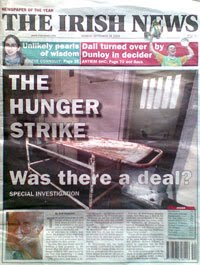
THE HUNGER STRIKE Was there a deal?
By Richard O’Rawe, for the Irish News
22/10/09

Richard O’Rawe – former republican prisoner, PRO of the 1981 hunger strikers and author of Blanketmen – responds to Sinn Fein president Gerry Adams on claims a deal was available which would have saved the lives of six hunger strikers

There is now no room for doubting that the hunger strikers, by their sacrifice and courage, melted the iron will of Margaret Thatcher.

In doing so they tore asunder the British government’s policy of criminalisation. Not only that, but the hunger strikers forced the British to make a substantial offer, which was passed to Brendan Duddy (the Mountain Climber) on 5 July 1981.

Martin McGuinness said in his September 28 Irish News article that he took the offer from Duddy and passed it on to Gerry Adams in Belfast.

I believe that, had that offer not been rejected by those republican leaders on the outside who ran the Hunger Strike, it would have spelt victory to the Blanketmen, proved to be a massive propaganda coup for the republican struggle and, most importantly of all, saved the lives of six hunger strikers.

I also believe that while other accounts of the period have crumbled under the weight of damning contemporaneous evidence, my version of events has been vindicated: there was an offer; Bik McFarlane and I did accept it; a comm from Gerry Adams came in to the prison leadership which said that ‘more was needed’.

A similar message was sent to the British government.

Besides Martin McGuinness, the former hunger striker Laurence McKeown contributed an article to The Irish News special edition.

In it Laurence made no direct reference to this offer, preferring instead to write about a conversation he had had with a BBC producer in the 1990s.

That prompts the question: had Laurence and the hunger strikers been made fully aware of the details of the Mountain Climber offer?

I do not think they were and Laurence McKeown’s own book, Nor Meekly Serve My Time, demonstrates this.

For example: on July 29 1981, at the request of the families and Mgr Denis Faul, Gerry Adams, Fermanagh and South Tyrone election candidate Owen Carron, and INLA leader Seamus Ruddy visited the hunger strikers, ostensibly to give them their assessment of the situation.

Thirteen years later, in 1994, Laurence recorded the visit in his book. On page 236 he wrote of Gerry Adams having visited hunger striker Kieran Doherty:

“On their way out of his cell Doc’s parents met and spoke with Gerry, Bik and the others. They asked what the situation was and Gerry said he had just told all the stailceoirí, including Kieran, that there was no deal on the table from the Brits, no movement of any sort and if the stailc continued, Doc would most likely be dead within a few days. They just listened to this and nodded, more or less resigned to the fact that they would be watching their son die any day now.”

Kieran Doherty TD passed away four days after Adams’s visit, believing that there ‘was no deal on the table from the Brits, no movement of any sort’.

What Adams seemingly did not tell Kieran’s dignified parents, Alfie and Margaret, was that, actually, there was a deal on the table from the Brits, and it had been there from before Joe McDonnell died.

Moreover, he did not tell them that there had been movement.

Adams did not tell Mr and Mrs Doherty – or their noble son – about the Mountain Climber offer.

According to Laurence McKeown, Adams did not tell any of the hunger strikers about the Mountain Climber offer. Worse still, he told them the opposite of what he knew to be the facts of the situation.

I believe that Adams misrepresented the situation and Bik McFarlane did nothing to correct him. That is hardly surprising since before Adams even set foot in the prison McFarlane told Pat ‘Beag’ McGeown ‘Don’t make your opinions known,’ at the forthcoming meeting.

Subsequently Pat Beag said, ‘When Gerry was in I didn’t say anything to him.’

In the face of all the evidence Sinn Fein has sought to demonise anyone who criticises their version of the Hunger Strike by representing that any condemnation of them automatically means that the hunger strikers had been dupes.

The hunger strikers were never dupes. In reality, like Pat Beag, they were very astute and politically-aware individuals, people who would not be ‘easily deceived or cheated’ by anyone.

Yet, like any of us, they could only make decisions on the basis of the information they had.

If those they trusted withheld vital information from them, their judgements would obviously have been impaired.

Besides Gerry Adams not having told them of the Mountain Climber offer, when he visited them on July 29, Bik McFarlane never told them that he and I had accepted the Mountain Climber offer.

Furthermore, like McFarlane and the rest of the prison leadership, the hunger strikers were never shown a copy of the British government’s offer.

In fact, none of us prisoners in Long Kesh were told that the offer came in the form of a statement from the then secretary of state for Northern Ireland, Humphrey Atkins, which the British, as documents recently disclosed under the Freedom of Information Act made clear, would have been released if and when the Hunger Strike ended.

So, why was this offer not sent in to the hunger strikers so that they could properly evaluate the attitude of the British?

Who took the decision to withhold it from them?

And the biggest question of all – why?

Sourced from the Irish News

Bernard Fox: Claims only add to pain

Claims only add to pain says ex-hunger striker
THE HUNGER STRIKE Was there a deal?
By Allison Morris, Irish News
22/10/09

bernardfox

UPSET: Bernard Fox today PICTURE: Hugh Russell

Former republican hunger striker Bernard Fox says he is deeply distressed by allegations that a deal which could have ended the strike was vetoed in order to maximise electoral support for Sinn Fein.

The west Belfast man, who spent a total of 22 years in prison, was on hunger strike for 32 days when the protest was ended.

Speaking to The Irish News Mr Fox said: “I was a close friend of Joe McDonnell. I was on active service with him on the outside, and later imprisoned with him.

“Under those circumstances you get to know a person’s character very well.

“Joe loved life and had no desire to die but he was determined and pragmatic and was not for settling for anything other than the five demands – that I can say for sure.

“I wasn’t in the hospital at that time and I don’t know what the men were told or not told but I do know that there was no deal.

“Offers, yes – there were plenty of offers.

“Sure wasn’t Kieran Nugent given an offer of a convict’s uniform in 1976, an offer he declined?”

Having been interned twice the former IRA man was returned to the Maze prison as a convicted prisoner in 1977 and immediately joined the blanket protest, before volunteering for the Hunger Strike.

He spent 32 days on hunger strike before the protest, which claimed the lives of seven IRA and three INLA prisoners, came to an end.

“It took me 20 years before I could even speak openly about my experiences,” he said.

“It’s still emotional and raw for me even now. These claims just add to that pain.

“I can only imagine what it must be like for the families of the 10 lads.

“Bik [McFarlane] was chosen to act as our OC [officer commanding]. It’s a job no-one envied – the pressure must have been unbearable.

“Regardless of what I or anyone else may think about the political direction he has taken since, at the time we knew he wasn’t going to let us down.

“To suggest that he in some way colluded with the outside leadership to let his comrades die is sickening to me and does not hold up to scrutiny.

“After the first hunger strike we, [the prisoners] were very clear we wanted our demands in writing and delivered by a representative of the British government so there could be no reneging this time.

“Look, I would never criticise any former blanketman. We all suffered equally and the comradeship we had at that time was the only thing that saw us through.

“But try as I may I cannot understand where some people are coming from or why they would wait all these years to bring this out.

“Thatcher and the British government are responsible for the deaths of our comrades – that’s where the blame lies.”

In 1998 Fox was released from prison under the terms of the Good Friday Agreement.

He has since parted company with Sinn Fein in disagreement over its political direction.

“I have no personal or political agenda,” he said.

“My only concern is for the families and how all this must be hurting them.

Addressing calls for a public inquiry, he said: “I have no time for inquiries. What you need is not an inquiry but the truth and it would be naive to think the British will ever tell the truth.

“If there are unanswered questions my advice would be to seek clarification.

“That way the families who have called on all this to stop can be left in peace.”

Sourced from the Irish News

Tony O’Hara: The truth about the Hunger Strike

The truth about the Hunger Strike
Tony O’Hara, Derry
Irish News Letters
22/10/09

I read with amazement the attempt by Gerry Adams (October 12) to win back some ground in the controversy over the Hunger Strike offers.

Most of his piece was spent demonising everyone who dared offer an opinion against the Sinn Fein line.

But Mr Adams’s opinion of any of these people doesn’t mean that what they have said is wrong.

The evidence has been growing and – as other avenues are explored – more evidence will come to light.

Let’s deal with some of the facts of the controversy.

Richard O’Rawe claims that he and Bik McFarlane had a conversation about ‘the Mountain Climber’ offer received in a communication in which O’Rawe said in Gaelic, ‘‘There is enough there’’ (to end the Hunger Strike). Bik agreed. This has been verified by two other prisoners who heard the conversation.

Bik claims this never happened. As well as his other contradictory statements, Bik on UTV live on March 1 2005 denied that any offer of any sort was ever made by the British at any point.

In March 2005, in an interview with The Irish News, Bik stated: “There was no concrete proposals whatsoever in relation to a deal.”

At Gulladuff he said he took the offer to the prisoners – they turned it down.

Kevin Lynch and Mickey Devine never heard this offer.

We know the offer came via Brendan Duddy – ‘the Mountain Climber’.

Yet Gerry Adams has stated that he never heard of ‘the Mountain Climber’.

Who overruled the POW leadership to reject the British offer that contained almost four of the five demands?

Did Gerry or any other members of the republican leadership get any other offers from the British?

On the issue of Garret Fitzgerald and censorship – Gerry’s own members have been trying to silence people talking about this – with threats, demonising etc.

Gerry should put some manners on them.

It should also be clarified that there was no family statement at Gulladuff.

The following day Sinn Fein members took a SF-composed statement around to some family members for them to sign.

My mother and I never signed it. Neither did Michael Devine (who was also at Gulladuff) or Louise Devine.

The British government were ultimately responsible for the deaths of our relatives.

We all agree on that.

But could some of the lives have been saved?

My family and Mickey Devine’s family are receiving tremendous support from hundreds of ex-POWs, republicans and nationalists in our quest to uncover the truth.

We are not selective about where evidence comes from. Facts are facts – it is the truth we are after.

At Gulladuff, I suggested that we invite all concerned into a room together to thrash things out. Gerry didn’t reply.

That suggestion is still there, only now I ask for it in public with an agreed international humanitarian as chairperson. Only that will end it.

Richard O’Rawe has agreed to attend, former taoiseach Garret Fitzgerald has also said he would cooperate with an inquiry.

Will Gerry?

I invite the readers of The Irish News to make up their own minds by visiting http://www.longkesh.info

Sourced from the Irish News

Ruairí Ó Brádaigh: In the interests of historical accuracy

In the interests of historical accuracy
Ruairi O Bradaigh, President of Republican Sinn Fein, Dublin 1
20/10/09

Arising out of recent publicity in The Irish News on the 1981 hunger strikes I wish to clarify certain matters.

- Dr Garrett Fitzgerald places Gerry Adams as president of Sinn Fein in 1981.

I was president at that time.

- Sinn Fein’s task in 1980-81 was to campaign in support of the hunger strikers.

Sinn Fein knew nothing of conditions alleged to be on offer for settlement of the strike.

- I do not believe that the army council of the IRA was aware of such alleged conditions either.

In the interests of historical accuracy I wish to place this information on the public record.

Sourced from the Irish News

Recent Items

Twitter Updates

Contents

Use this link to access all contents

New to Archive


There's an inner thing in every man, Do you know this thing my friend? It has withstood the blows of a million years, and will do so to the end.